



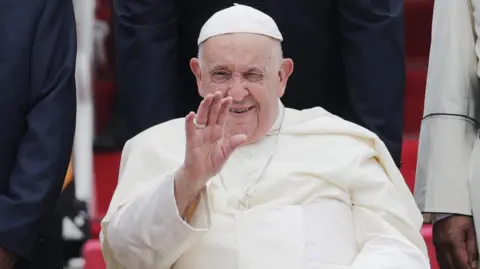
Pope Francis, the 266th leader of the Roman Catholic Church and one of its most influential reformers, has been laid to rest at the Basilica of Santa Maria Maggiore in Rome, marking a deeply emotional and historic farewell.
The Vatican confirmed that the burial took place today, sparking an extraordinary wave of devotion from around the globe.
Click here to join our WhatsApp Group and Receive Daily News
Italy’s Interior Minister, Matteo Piantedosi, announced that approximately 400,000 mourners filled Vatican City for the funeral rites, while another 150,000 lined the streets of Rome to witness the solemn procession escorting the Pope’s coffin to its final resting place.
According to Vatican reports, around 250,000 people gathered in and around St Peter’s Square for the funeral Mass, a testament to Pope Francis’ profound global influence.
Today also marks the beginning of the Novemdiales — a traditional nine-day mourning period, during which daily Masses will be held in honor of the late pontiff.
Even as the Church grieves, attention is slowly turning toward the upcoming conclave to elect Francis’ successor, expected to commence after May 6.
Born Jorge Mario Bergoglio in Buenos Aires, Argentina, in 1936, Pope Francis made history in 2013 as the first Latin American and the first Jesuit to be elected pope.
For over a decade, he led the Church with a spirit of humility, advocating for the poor, defending the rights of migrants, and pushing for urgent action on climate change.
His choice of the papal name “Francis,” after Saint Francis of Assisi, reflected his deep commitment to simplicity, peace, and care for creation.
Throughout his papacy, Francis became known for steering the Church toward a more compassionate and inclusive stance on controversial issues.
He softened the Church’s tone on homosexuality, promoted interfaith dialogue, and emphasized mercy over judgment.
His landmark encyclical Laudato Si’, addressing environmental stewardship, gained worldwide acclaim and reshaped Catholic engagement with ecological issues.
Despite his progressive vision, his leadership faced significant hurdles, including resistance within Church ranks, the continuing crisis of clerical sexual abuse, and geopolitical tensions as he worked to position the Vatican as a global advocate for peace.
Francis’ burial at Santa Maria Maggiore marks a break from more than a century of tradition; he becomes the first pope since Leo XIII in 1903 to be interred outside Vatican grounds.
The basilica holds special personal significance for Francis; after each international journey, he would visit the church to offer prayers of gratitude to the Virgin Mary.
His devotion to Mary was central to his spiritual life, making Santa Maria Maggiore — the first church dedicated to her in the 4th century — a deeply meaningful final resting place.
As Rome’s bells tolled and prayers echoed worldwide, Pope Francis was honored not only as a Church leader but as a pastor who brought the voices of the marginalized to the forefront of a rapidly evolving world.
Though he now rests beneath the ancient arches of Santa Maria Maggiore, his enduring vision for a more compassionate, inclusive Church continues to inspire.
Also Read: Amama Mbabazi’s Daughter Wanted Over Unpaid Shs 450m Loan