





The government will launch a nationwide mass enrollment and renewal campaign on May 27, aiming to reach over 33 million Ugandans. This includes 15.8 million whose national IDs will expire by June 2025 and another 17.2 million citizens who have never been registered.
The initiative, spearheaded by the National Identification and Registration Authority (NIRA), was officially launched by State Minister for Internal Affairs Gen. David Muhoozi at the ministry’s headquarters in Kampala on Monday. He said the exercise follows extensive planning and a successful pilot phase.
“The pilot, which started on May 2 and ends on May 26, allowed us to evaluate systems, equipment, and procedures. We’re now set to begin full-scale operations in all 146 districts from May 27,” Muhoozi said.
NIRA, established under the Registration of Persons Act, is responsible for maintaining Uganda’s National Identification Register, which already contains biometric and biographic data for over 27.7 million people. This mass exercise aims to modernize identity management ahead of key national activities such as the 2026 general elections.
Click here to join our WhatsApp Group and Receive Daily News
Muhoozi noted that the campaign is a response to the upcoming expiration of a large number of ID cards and increased demand for ID services. The cabinet approved the exercise in August 2022.
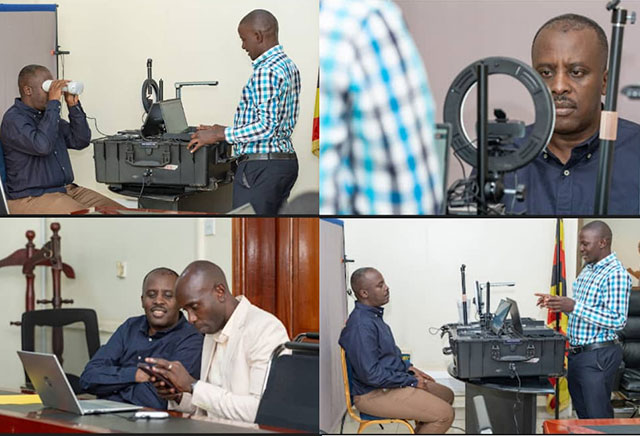
To support the effort, the government has invested in modern technology and infrastructure. In July 2024, NIRA signed a contract with Tahaluf Al Emarat Technical Solutions to supply 5,665 biometric registration kits, all delivered by January 2025. Additionally, two high-capacity card production machines capable of printing up to 100,000 laser-engraved cards per day were installed in March 2025.
The system also features online pre-registration, launching the same day as the national rollout. “From May 27, registration teams will be stationed in every parish, working on a rotational basis coordinated with local governments,” Muhoozi said. Services will include free renewals and first-time registrations, corrections of personal details (at UGX 200,000), and replacement of lost cards (at UGX 50,000).
The new kits are equipped with iris scanners to improve biometric accuracy. Applicants must provide identification documents—expired IDs or police reports for renewals and proof of parentage or ancestral ties for first-time applicants, often verified by local leaders.
Muhoozi urged Ugandans to take part promptly. “A national ID is essential for planning, service delivery, and security. We must ensure everyone is included,” he emphasized.
The entire renewal process is expected to be completed by August 12, 2025—the official deadline for expired IDs. Initially, processing may take up to four weeks, but this will reduce to two weeks as systems stabilize.
The minister also cautioned citizens against re-registering if they already have a National Identification Number (NIN), recommending the use of the Change of Particulars service for updates instead.
Also Read: Amama Mbabazi’s Daughter Wanted Over Unpaid Shs 450m Loan