






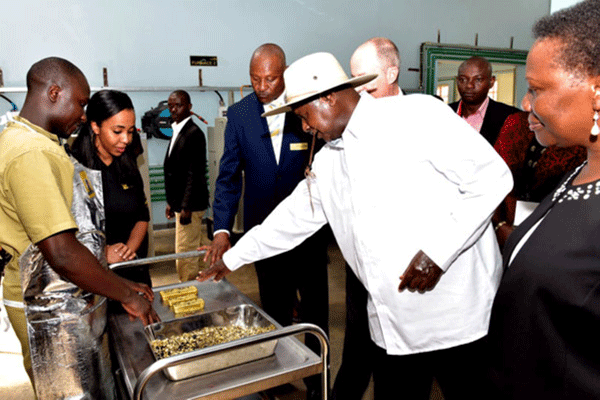
The Auditor General has uncovered gross irregularities in the management of Uganda’s natural resources causing substantial revenue losses.
Gold exports worth $3.014 billion (equivalent to Shs 11 trillion) were conducted without obtaining the legally required export permits from the minister of energy.
The Auditor General states that this practice undermines Uganda’s regulatory framework and deprives the government of crucial revenue. Unpaid export levies relating to these transactions amounted to Shs 68.842 billion, indicating a lack of enforcement in tax collection.
The report further highlighted that exploration and mining companies owe Shs 439 billion in outstanding mineral rent fees, a violation of the Mining and Minerals Act. Despite these mounting arrears, enforcement mechanisms remain weak.
The Auditor General noted that the unlawful exports had, therefore, led to a loss of government revenue, with unpaid gold export levies accumulating to Shs68.84b, while at the same time the government was unable to verify the origin and purity of the exported gold.
“In the 2023/24 [financial year], $3.01b in gold exports occurred without permits, preventing origin and purity verification… resulting in Shs68.84b in cumulative unpaid export levies,” the report reads in part.
Data from the Bank of Uganda indicates that during the 2023/24 financial year, Uganda exported 48,620 kilograms of gold, valued at Shs11.4 trillion.
The revelation by the Auditor General, therefore, means that 96.49 percent of the gold was exported during the period without permits.
Asked how this could have happened, Energy State Minister Sidronius Opolot Okasai yesterday said the permits had been issued retrospectively after the government had lifted a suspension on gold exports, which had resulted from a tax dispute between exporters and the government.
Click here to join our WhatsApp Group and Receive Daily News
In 2022, dealers suspended gold exports after the government imposed a 1 percent levy on every kilogram of gold. However, government later caved in to the demands of the exporters and instead proposed a $200 charge per kilogramme, which was later endorsed under the amended Mining
Gold exports continue to be challenging in relation to meeting regulatory requirements. For instance, in November last year, Uganda Revenue Authority (URA) data indicated that large amounts of money in gold taxes remained unpaid months after dealers had exported the commodity, contravening the Mining and Mineral (Export of Refined Gold) Regulations, which require taxes to be paid at the time of export.
URA data indicated then that 90.26 percent of taxes that had been assessed on gold during the 2023/24 financial year remained unpaid.
Data further indicated that whereas URA had assessed taxes on 46,263 kilograms worth Shs34.77b, only Shs3.39b, representing 9.74 percent, had been paid four months after the end of the 2023/24 financial year.
“4,484 kilograms were assessed and [Shs 3.39b] paid in taxes. 41,779 kilograms were assessed, and [Shs31.38b] is pending payment,” URA data indicated last year.
The Mineral Royalties’ Sharing Fund account within the ministry of Energy received Shs 5.69 billion during the year, which, combined with a closing balance of Shs 1.36 billion from the previous financial period, totaled Shs 7.05 billion. However, only Shs 3.14 billion was distributed to beneficiaries, leaving Shs 3.91 billion unaccounted for.
The auditor general further called for stronger follow-up mechanisms to recover outstanding mineral rent fees and enforce compliance with legal provisions. It was recommended that the Ministry of Energy invoke penalty clauses under Section 149(5) of the Mining and Minerals Act to deter non-compliance by mineral exporters and exploration companies. By doing so, the government could recover lost revenues and strengthen its regulatory oversight in the sector.
Also Read: Authorities Launch Investigations as Anthrax Kills Two in Kazo