


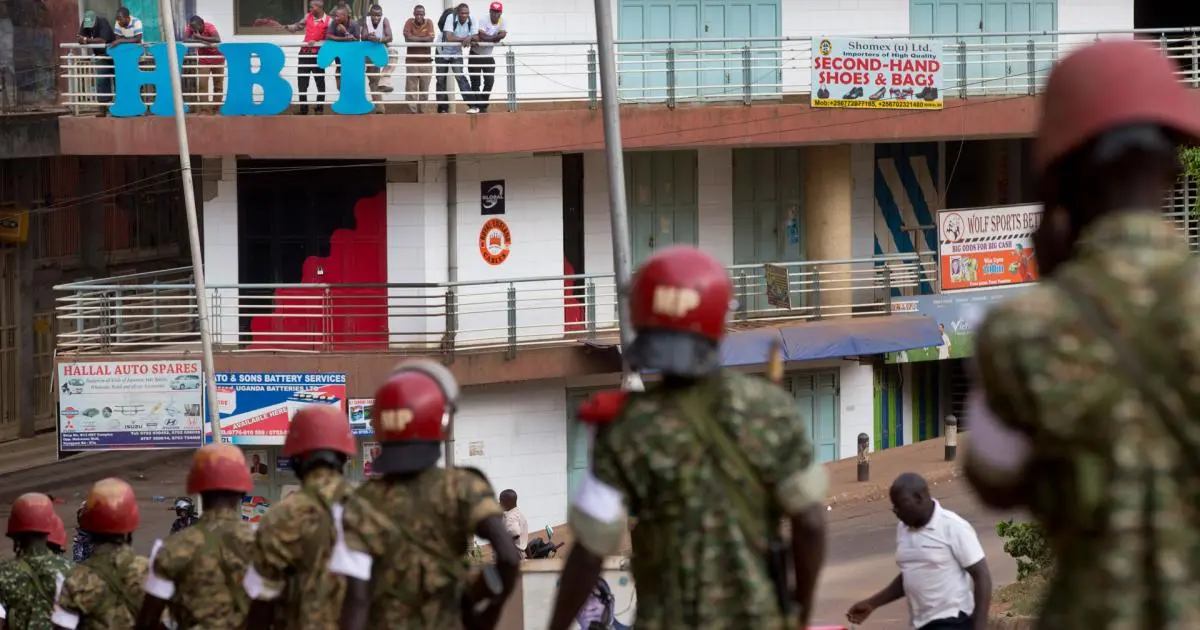
A new report by two Ugandan research organizations has accused the country’s military of overstepping its constitutional mandate and assuming increasing control over civilian governance—a charge the army has strongly denied.
The report, Guns Everywhere: The Military and Transition Politics in Uganda, was jointly published by the Great Lakes Institute for Strategic Studies and Innovations for Democratic Engagement and Action. It argues that the Uganda People’s Defence Forces (UPDF) has evolved from a traditional defense institution into a dominant political actor at the center of state power.
“The military is no longer a tool of the state. It has become the state,” said Godber Tumushabe, assistant director at the Great Lakes Institute.
‘Power No Longer Belongs to the People’
The authors claim that Uganda’s 1995 Constitution, which promises that power resides with the people, has been undermined by a growing military presence in public life. They cite examples of army influence in elections, cultural institutions, religious bodies, and economic affairs.
They also warn of increasing violence in Uganda’s political sphere, attributing this to the military’s rising involvement in electoral processes.
The recent UPDF Amendment Act of 2025 is singled out as a key development, allegedly legalizing previously informal and unconstitutional military units such as the Special Forces Command and Reserve Forces. Tumushabe described this as “a complete bypassing of democratic norms.”
Echoes of Uganda’s Authoritarian Past
The report draws comparisons to Uganda’s past military regimes, particularly under Idi Amin. It accuses the UPDF of involvement in human rights abuses, including torture, abductions, and extrajudicial killings.
“As President Museveni’s grip on power weakens, his dependence on the military deepens,” Tumushabe said, suggesting a return to the tactics of the National Resistance Army (NRA), the rebel force that brought Museveni to power in 1986 and was later rebranded as the UPDF.
The study further argues that the military no longer operates as a neutral national institution but rather as a political tool to ensure regime continuity.
Police ‘Disempowered,’ Oversight Deteriorating
A significant portion of the report focuses on what it describes as the erosion of civilian oversight. It claims that elite military units—such as the Special Forces Command and the Joint Anti-Terrorism Task Force—frequently act with impunity and little accountability, while police forces are often sidelined.
“Lines of responsibility have completely blurred,” said Tumushabe. “The UPDF operates unchecked in many cases, while police are left disoriented and powerless.”
The report concludes with a stark warning: as Uganda approaches the 2026 general elections, the unchecked power of the military could further destabilize the country’s fragile democratic institutions.
UPDF Responds: “We Are a National Institution, Not a Regime Army”
In response, UPDF spokesperson Maj. Gen. Felix Kulayigye dismissed the report as “intellectually bankrupt” and “deeply biased.”
Speaking to the media, Kulayigye criticized the authors for failing to consult the military while compiling the report. “If you’re going to write about the military, shouldn’t you at least speak to the military?” he asked.
He strongly rejected suggestions that the UPDF is overreaching its role, insisting the army operates strictly within the law. “We follow the Constitution and the UPDF Act. We are accountable to civilian authority and do not act on personal orders,” he said.
‘Stepping In Where Others Fail’
Kulayigye defended the military’s growing involvement in areas traditionally managed by civilian institutions, arguing it is often called upon to step in due to failures in public service delivery.
He cited the UPDF Engineering Brigade’s recent renovation of Namboole Stadium—completed at a significantly lower cost than initially projected—as an example of effective service. “If civilian agencies are inefficient or corrupt, should the president fold his arms and do nothing?” he asked.
The UPDF, he said, is “stepping up, not overstepping.”
Military Visibility ‘A Response to Civilian Weakness’
The general also expressed concern about what he sees as the politicisation of academic research. “More and more, scholars are pushing partisan narratives under the guise of analysis,” he said.
He emphasised that the UPDF is a disciplined, professional force recognised both domestically and abroad—for instance, in peacekeeping missions in Somalia and South Sudan.
What Next?
As Uganda’s political climate heats up ahead of the 2026 elections, debate over the role of the military in governance is expected to grow. While the report calls for renewed focus on democratic oversight and civilian authority, the UPDF insists it is merely fulfilling national responsibilities amid institutional weaknesses.
The central question remains: is the military preserving stability—or quietly reshaping Uganda’s democracy from within?