



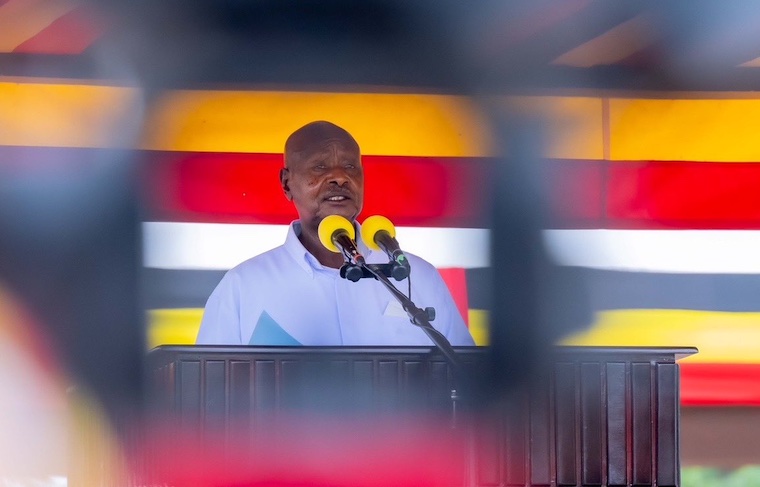
President Yoweri Museveni has emphasized that poverty is a personal issue and should not be attributed to the government, which consistently strives to launch development projects benefiting all citizens.
Speaking at the 62nd Independence Day celebrations in Busia, eastern Uganda, the president outlined the limitations of government employment and urged citizens to take charge of their own economic futures.
While acknowledging the government’s efforts to uplift citizens from poverty, Museveni noted that it is unrealistic for the public to expect the government to employ every qualified individual. He explained that government jobs are inherently structured with limited vacancies, offering far fewer opportunities than the nation’s large population demands.
Museveni stressed that Ugandans should manage their expectations regarding government jobs, encouraging them to create their own opportunities or seek employment in the private sector.
He illustrated his point by explaining that one teacher is needed for every 50 students, meaning the government only needs to employ approximately 300,000 teachers. Similarly, with just one resident district commissioner (RDC) per district, one parish chief per parish, and a limited number of doctors, it is clear that the government cannot provide jobs for everyone, he said.
The president criticized politicians who perpetuate the belief that the government can employ everyone, reminding the public that the total number of available government positions is only about 470,000. His remarks come at a time of increasing concern over unemployment, especially among the youth, who make up the majority of Uganda’s population and face limited job opportunities.
To further support economic growth, Museveni announced plans to construct the standard gauge railway (SGR) from Kasese to Malaba, funded by expected petroleum revenues. He also urged citizens to actively engage in government-led poverty alleviation programs such as the Parish Development Model (PDM), Emyooga, and Operation Wealth Creation (OWC).
Reflecting on Uganda’s history, Museveni recalled that when the country gained independence in 1962, only 9 percent of households were part of the modern cash economy. The remaining majority, he noted, faced poor health, poverty, lack of education, ignorance, and malnutrition, issues driven by politics of identity, tribalism, and gender discrimination.
He further attributed part of Uganda’s economic decline to former President Idi Amin’s expulsion of the Asian community, which had played a key role in the country’s entrepreneurial class. Amin’s actions, combined with black market activity, speculation, and smuggling, exacerbated the country’s economic woes, he said. Despite these challenges, Museveni credited his government with restoring prosperity, ensuring strategic security, and promoting African solidarity.
Museveni highlighted that by the 1960s, affluence was primarily concentrated in Eastern Europe and Japan, while much of the rest of the world remained impoverished. He urged Ugandans to reject divisive identity politics, arguing that it would hinder economic development. He also emphasized the potential for wealth creation through regional trade, using the example of tribes that produce milk and sell it to areas where it is scarce.
On the topic of Uganda’s economic prospects, Museveni highlighted the value of coffee on both national and international markets, advising farmers to focus on cultivating cash crops. He also pointed out Uganda’s success in milk production despite opposition and shared the government’s focus on building industries around raw materials, such as textiles and gold. Additionally, Uganda is investing in a knowledge-based economy, targeting sectors like automotive manufacturing, vaccine production, and pharmaceuticals.
Expressing concern for those living on the margins, Museveni referenced reports showing that 67 percent of Ugandan households are part of the cash economy, while 33 percent have yet to fully engage with it. He vowed to return to this issue in future addresses, noting that those who have not joined the cash economy are not taking full advantage of government development programs.
Museveni concluded by sharing his vision for growing Uganda’s economy to Shs 500 billion, urging all citizens to join him in the fight against poverty. Reflecting on his journey to Busia, he noted the impressive infrastructure but also saw signs of poverty in some households along the road.
Furthermore, Museveni urged all patriots to work towards East African economic integration and warned against replicating the fragmented economies seen in Latin America. He praised his son, Chief of Defense Forces (CDF) Gen. Muhoozi Kainerugaba, for organizing a shorter, more efficient parade.
At the event, 40 individuals, including police officers and members of the Uganda People’s Defense Forces (UPDF), were honoured with medals for their contributions to Uganda’s independence. Among the foreign dignitaries in attendance was Central African Republic President Faustin-Archange Touadéra, who commended Museveni for maintaining peace, fostering hospitality, and promoting regional integration.