





Following the garbage slide at Kiteezi landfill, survivors are grappling with loss and uncertainty as they seek answers and assistance amidst their shattered lives.
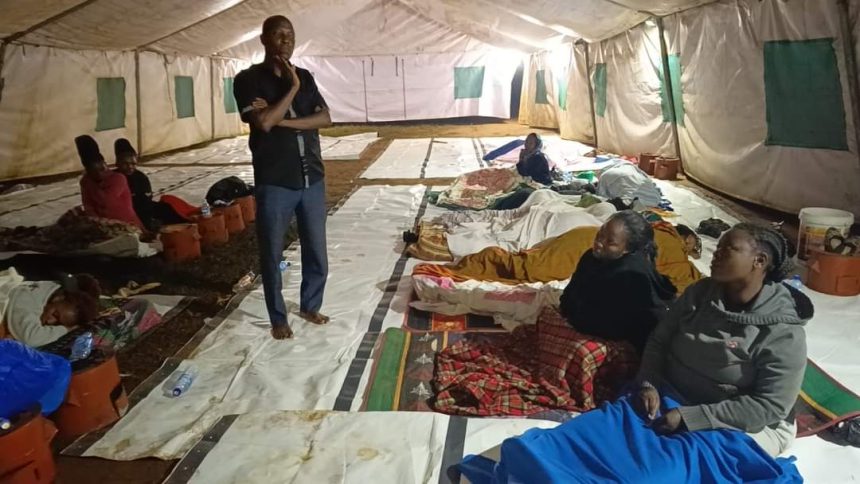
As one approaches the camp, the scene is marked by the presence of well-wishers and NGOs coming to the aid of the victims, providing much-needed necessities to help them transition to this new phase of life brought about by the disaster.
This disaster has resulted in over 356 people losing their livelihoods and the hope they once had. Currently, the internally displaced people affected by the garbage slide are housed at the Kiteezi football pitch, with the camp being managed by the Red Cross and the Office of the Prime Minister. These organizations are providing shelter, food and medical care to those impacted by the disaster.
DISEASES SURGE AT THE CAMP
Amable Ayebare, the incident commander for the Kiteezi public health response from the Directorate of Public Health and Environment at Kampala Capital City Authority (KCCA), spoke to The Observer about the current health conditions at the camp housing victims of the Kiteezi landfill disaster.
“Currently, we have quite a number of people on medication, and the majority of cases we’re seeing involve diarrheal disease in children, especially those under the age of two,” Ayebare said.
“This has been attributed to the changing environment, changing meals, changing sleeping arrangements, and children interacting with each other. We’ve also observed an increase in coughs and flu among the children, though only a limited number of cases have progressed to pneumonia.”
Ayebare noted that the camp is also dealing with cases of gastritis and stomach upsets, which have arisen due to changes in feeding patterns, with many people going from four meals a day to just one or two.
“We also have a lot of coughs and flu among adults and a significant number of infections,” she added. “At the start, when hygiene was not yet fully under control, we were seeing a lot of urinary tract infections and cases of candida, but now these are decreasing due to improved hygiene and the availability of medical supplies.”
Ayebare highlighted that the outpatient clinic set up by KCCA at the camp includes a psychosocial support arm, with a psychiatric nurse conducting assessments and a team of counselors from the Uganda Counseling Association providing support. This has enabled the referral of victims for additional psychosocial care.
She also pointed out that KCCA has provided an opportunity for women to catch up on immunizations and has offered free antenatal services for pregnant women.
SURVIVORS SHARE THEIR EXPERIENCES
“We have quite a number of pregnant women in this camp—about 12 at different stages of pregnancy,” Ayebare noted. “Since most of them lost all their documents in their houses, we conducted a round of antenatal care services, issued new antenatal cards, and are now able to follow up with them even after the Kiteezi landfill disaster.”
When The Observer reached out to some of the survivors of the Kiteezi landfill disaster, they shared their harrowing experiences. Muhammad Kironde, a butcher working with the Kalerewe abattoir and a resident affected by the landfill disaster, recounted his loss. He said he lost four children, his wife and his livestock— goats and cows—in the garbage slide.
“I don’t know what to do next. I have lost everything. We get food and supplies from the camp, but I don’t know what comes next moving forward because everything I had was destroyed on that fateful day when the garbage slide occurred. I had cows, goats, and rental houses; it all went away, and I was left with nothing,” Kironde shared with this newspaper.
Additionally, Kironde expressed his concerns, telling this newspaper, “There have been rumors that the government wants to relocate survivors to Ddundu in Mukono district, but they haven’t informed us officially. It’s not right for the government to move us to an unfamiliar place when they found us on our properties and chose to dump garbage in the area where we lived.”
Although President Museveni ordered compensation payments to the victims—five million shillings for each fatality and one million shillings for each injured person—Kironde pointed out that most of the garbage slide survivors have not received their promised compensation in full.
“I lost five people and have only received five million shillings so far, yet the government promised five million shillings per victim lost in the garbage slide. When I inquired about this with the head of police at the internally displaced camp, he assured me that it’s being handled. So, I’m waiting for feedback, but I’m confused and don’t know what to do next with my life because all of my investments were destroyed in the garbage slide,” he lamented.
Lauya Nalubega, a mother of two who lost her husband during the garbage slide at Kiteezi landfill, broke down in tears and was in a state of despair while speaking to correspondents of this newspaper. She expressed gratitude for the help coming from well-wishers, organizations like the Red Cross, and government institutions such as the Office of the Prime Minister, but she is deeply worried about how she will raise her children on her own without a place to live or money to support their education.
“Before the landfill disaster, my husband used to collect grass to feed the cows that provided us with milk, which we sold to earn a living. But now, with my husband gone, I’m worried sick about how we are going to survive without his help. I fear my children won’t be able to go back to school,” Lauya shared.
Hussein Kato, another survivor from the Kiteezi landfill disaster, shared his harrowing experience with this paper, revealing that he lost both his wife and child. He is still waiting to recover his child’s body. “I am hoping and being patient. I believe God has a plan and a reason for everything that happens. One thing I have learned in this world is that God knows everyone’s destiny here on earth,” Kato said.
Jane Namanda, another survivor of the Kiteezi landfill disaster, told The Observer that she lost her house and a rental unit she had worked tirelessly to establish.
“After the landfill disaster, I was traumatized and couldn’t speak properly, but thanks to the psychological services provided at the camp, I was able to come to terms with the situation. However, I’m still not used to sleeping with so many people in one tent. Sometimes, I feel like leaving the camp and renting a small house so I can have some peace of mind,” Namanda stated.
She also expressed concern for her children, who are currently staying with a friend, and hopes to rebuild what she lost in the disaster.
COMMENTS FROM THE OFFICE OF THE PRIME MINISTER
When The Observer reached out to Charles Odongotho, spokesperson for the Office of the Prime Minister, to inquire about the plans for relocating and resettling those affected by the Kiteezi landfill disaster, he said, “The cabinet is going to have a meeting on Monday, August 26, to discuss and plan how to relocate the survivors of the Kiteezi landfill disaster.”
Odongotho also clarified that, “It may be true that some survivors haven’t received their compensation because steps are being taken to ensure that the money doesn’t end up in the wrong hands.”
He further explained that the disaster at the Kiteezi landfill led to the destruction of 51 houses, with 24 additional houses removed to create space for excavators to recover bodies. As of now, over 35 bodies have been retrieved from the landfill, though the search for the 28 missing bodies continues.
Odongotho noted that the people affected by this disaster fall into three categories: “Those whose homes were destroyed by the garbage slide, those whose houses were demolished to make way for excavators, and the group of people found within 200 meters of the landfill to create a buffer zone.”
COMMENTS FROM THE SPOKESPERSON OF RED CROSS
Irene Nakasiita, the head of communications at the Uganda Red Cross Society, expressed deep gratitude for the outpouring of support from Ugandans in response to the Kiteezi landfill disaster.
“We’ve seen people coming through every day to offer their support. It hasn’t been easy, but since we called for help, numerous groups have contributed whatever they can. We are incredibly grateful, honored, and appreciative. Thank you, Ugandans, for the great spirit of compassion and family that you have shown to the people of Kiteezi. We continue to call upon others who may have anything to offer.
Anything you can give means a lot to the lives of these people,” Nakasiita said. Nakasiita noted that although the camp currently houses over 356 people, she anticipates that the number of residents will increase due to the government’s plan to evacuate people living within 200 meters of the landfill, which will likely lead to more individuals seeking refuge at the camp.
Addressing the challenges faced by the Red Cross in managing the camp, Nakasiita highlighted that children are experiencing issues with pneumonia, exacerbated by the rainy season and cold winds. She praised the health team from KCCA for their diligent efforts in addressing the health concerns of the displaced residents. Critical cases have been referred to nearby health centers for further treatment.